
Most people can identify something they want to improve. The harder challenge is turning an intention into a change that lasts.
The 6M’s of Business Growth is a methodology for understanding how sustainable change develops. Although its name reflects its use within Business Growth Global, the methodology can also be applied to leadership, career, personal development or any other area where lasting change matters.
On Business Growth Global, we use it to help owners and leaders understand the human side of business change. You may decide to delegate more, improve margins, build a stronger leadership team, spend less time firefighting or create better boundaries around work. The intention is real. Then day-to-day pressure returns and familiar habits take over.
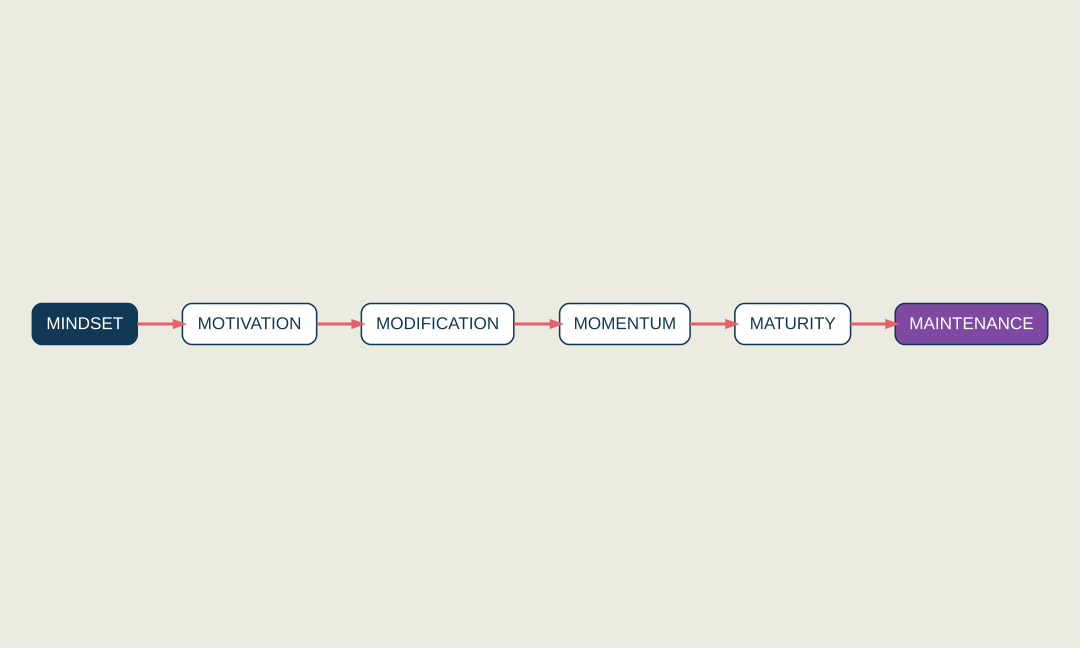
The six stages are:
Mindset → Motivation → Modification → Momentum → Maturity → Maintenance
Mindset: what are you believing about the situation?
Change often starts before any action is taken. It starts with how the owner interprets the problem.
An owner who believes “Nobody can do this as well as I can” will approach delegation differently from one asking “What would need to be true for somebody else to do this well?”
Mindset is not positive thinking. It is about examining beliefs, assumptions, identity and perspective.
Questions to explore include:
- What am I assuming to be true?
- Which belief is helping me?
- Which belief could be keeping the business dependent on me?
- What might I see differently if I stepped outside the immediate pressure?
Motivation: why does the change matter?
Knowing what should change is rarely enough. There needs to be a reason strong enough to compete with the comfort of the familiar.
That reason may be commercial, such as improving profit or business value. It may also be personal, such as spending more time with family, reducing constant pressure or regaining enthusiasm for the business.
The clearer the connection between the change and the outcome that matters, the easier it becomes to sustain effort when progress is uncomfortable.
Modification: what will actually be different?
This is where intention becomes behaviour.
Modification might involve changing a meeting rhythm, pricing decision, role, system, process, boundary, habit or leadership behaviour.
A useful question is: If somebody observed the business next month, what would they physically see happening differently?
If the answer is unclear, the change may still be an aspiration rather than an action.
Momentum: how will progress become consistent?
One good week does not create transformation.
Momentum develops when useful actions are repeated, measured and protected from the noise of everyday work. Small improvements can then compound.
This stage often benefits from simple accountability. What are you doing? How often? What result are you looking for? When will you review it?
Maturity: when does the new approach become normal?
Maturity is reached when the business no longer relies on extraordinary effort to maintain the improvement.
For a leader, this might mean genuinely operating at a more strategic level rather than repeatedly returning to old tasks. For a team, it may mean decisions are made confidently without unnecessary escalation. For a process, it may mean consistent outcomes no longer depend on one expert.
This is where growth starts to feel more controlled and predictable.
Maintenance: how will you stop yourself slipping backwards?
Successful change still needs attention.
New people join. Markets move. Pressure increases. Old habits can quietly return.
Maintenance means reviewing what is working, reinforcing successful behaviours and adapting when circumstances change. It is not about freezing the business. It is about preventing useful progress from disappearing.
Why this matters for overwhelm
Many owners attempt change by jumping straight to Modification. They create a new process, buy software, restructure a role or make a resolution to work differently.
But if Mindset and Motivation have not been explored, the old behaviour often returns. If Momentum is not built, the new action fades. If Maintenance is ignored, progress can be lost after the immediate pressure passes.
The 6M’s gives a way to think about change as a developmental cycle rather than another task to add to the list. The same sequence can be used whether the change is commercial, professional or personal.
Where are you in the cycle?
Choose one change you want to make in the business and ask:
- Mindset: what am I thinking or assuming about this?
- Motivation: why does changing it matter enough?
- Modification: what will I do differently?
- Momentum: how will I keep doing it?
- Maturity: what will tell me the new approach has become established?
- Maintenance: how will I protect the improvement?
You may discover that the difficulty is not the change itself. It is the stage that has been skipped.
Business Growth Global uses The 6M’s of Business Growth methodology alongside the AEROPS Framework and the LPAD methodology. AEROPS helps identify what needs attention, The 6M’s of Business Growth helps sustainable change take hold, and LPAD helps recurring work become less dependent on one person.
Related Insights
- What Is AEROPS? A Practical Framework for Sustainable Business Growth
- Owner Freedom: Why It Belongs in Your Growth Strategy
- Vision and Mission: A Practical Guide for Growing Business Owners
If you want space to think through a change in your own business, business mentoring can help you understand what is getting in the way and what needs to happen next. Book your 30-minute Clarity Session.