
Business growth becomes confusing when every problem appears to need a different model, tool or initiative.
One week the issue is sales. The next it is people. Then the owner needs more time, a process needs fixing or profitability comes under pressure.
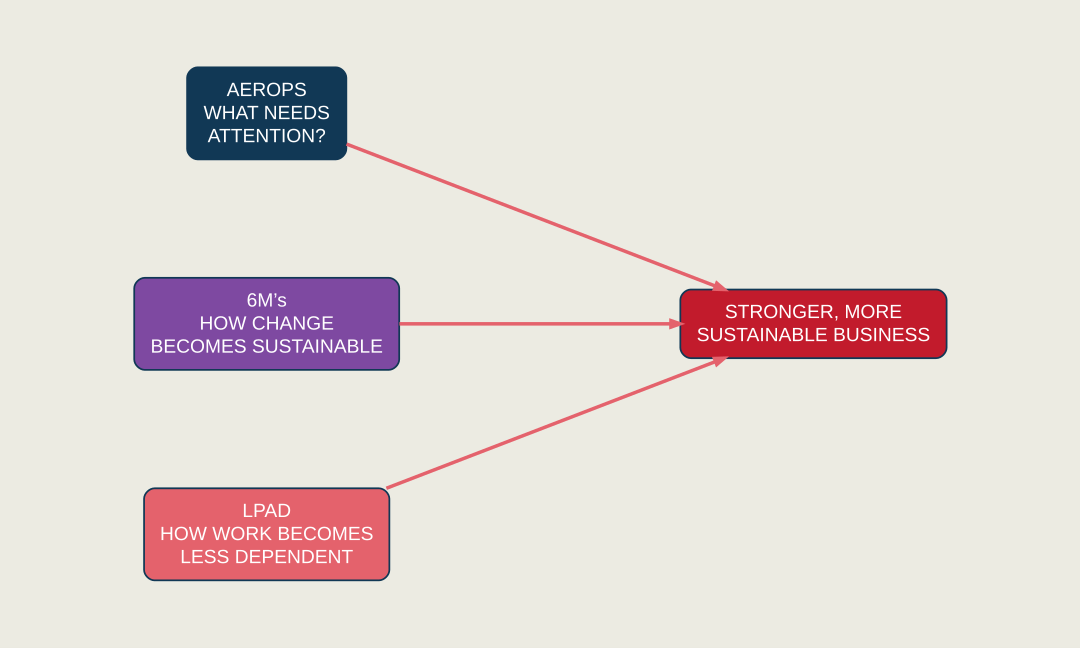
Business Growth Global uses the AEROPS Framework alongside The 6M’s of Business Growth methodology and the LPAD methodology. Each has a distinct job, and together they help separate diagnosis, change and systemisation without turning growth into a complicated programme.
AEROPS: what needs attention?
Analyse → Expand → Revenue → Operations → People → Success
The AEROPS Framework provides the whole-business view.
It helps an owner look across direction, commercial performance, delivery, systems, people and the outcomes the business is ultimately meant to create.
The objective is to avoid treating a symptom in isolation.
For example, a sales problem may actually be a positioning problem. A people problem may be a process problem. An owner time problem may be a delegation and role-design problem.
AEROPS helps frame the question: where is the real constraint?
The 6M’s of Business Growth: how does sustainable change happen?
Mindset → Motivation → Modification → Momentum → Maturity → Maintenance
Once an issue has been identified, change still has to happen.
The 6M’s of Business Growth methodology focuses on the human and developmental side of that change.
What assumptions need challenging? Why does the change matter? What will actually be different? How will consistency develop? When has the new approach matured? How will the improvement be maintained?
This helps explain why apparently sensible business changes sometimes fail to stick.
LPAD: how does recurring work become less owner-dependent?
Learn → Perfect → Automate → Delegate
The LPAD methodology focuses on activities and processes.
Where knowledge lives with the owner or a single expert, LPAD provides a route for understanding the task, improving it, removing unnecessary manual effort and transferring responsibility appropriately.
Its shorthand purpose is simple: turn what you know into a system the business can execute without depending on you.
An example: the owner approves every quote
Imagine a growing company where every significant quote requires owner approval.
Using AEROPS
You might explore several areas. Is pricing clear? Are margins understood? Are sales roles properly defined? Is the process unnecessarily complex? Does the team have the required authority or capability?
AEROPS prevents us from assuming that “the owner needs to delegate” is the entire answer.
Using The 6M’s of Business Growth
The owner may need to examine a belief such as “If I do not check it, we will lose margin.” That is Mindset.
Motivation might come from wanting time for strategic work or reducing constant interruption.
Modification could involve a clear approval threshold. Momentum comes from using it consistently. Maturity develops as the team gains confidence. Maintenance means reviewing outcomes rather than taking the task back after the first mistake.
Using LPAD
Learn how quotes are really built. Perfect the pricing rules. Automate appropriate calculations or templates. Delegate quoting within defined authority.
Now the business issue, behavioural change and process design support one another.
You do not need to use all three every time
Using the AEROPS Framework alongside two methodologies does not mean forcing all three into every issue.
Sometimes AEROPS is enough to create clarity. Sometimes an owner knows exactly what needs attention and the useful conversation is about Motivation or Momentum within The 6M’s of Business Growth. Sometimes the issue is a recurring operational task and LPAD is the most appropriate methodology.
The tool should serve the decision, not become the decision.
A useful sequence when you feel overwhelmed
When too many issues are competing for attention, try three questions:
- AEROPS: What area of the business is creating the greatest constraint?
- 6M’s: What stage of change are we actually at?
- LPAD: Is there recurring work here that needs to become less dependent on one person?
You may find that the problem becomes smaller and more manageable when these questions separate diagnosis, change and systemisation.
The overall objective
The purpose of the framework and methodologies is not to make the owner an expert in models or terminology.
It is to help build a stronger business with better commercial performance, clearer leadership, less unnecessary dependency and a more sustainable experience for the people running it.
Explore the AEROPS Framework or use business mentoring to work through where your business is now, what needs to change and what deserves attention next. Book your 30-minute Clarity Session.