
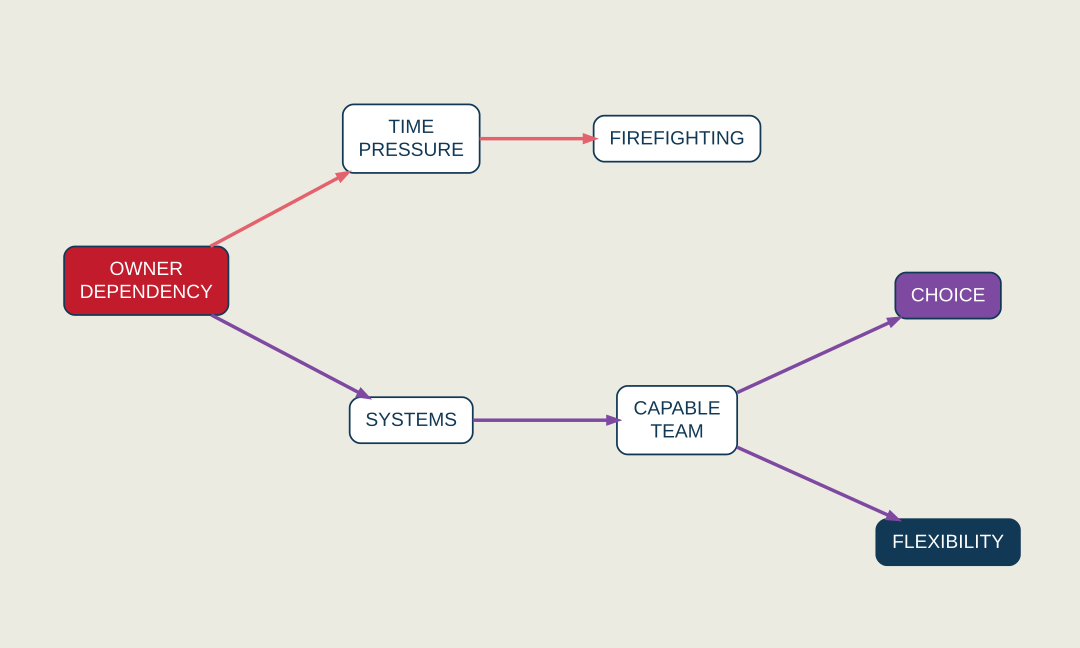
A business can be successful on paper while giving its owner very little freedom.
Revenue may be growing. The team may be expanding. Customers may be happy. Yet the owner cannot take a genuine break, every important decision reaches them and the business seems to consume more of their time each year.
That raises a question worth asking early in the growth journey: What is the business meant to create for its owner?
Growth and freedom are not automatically the same thing
It is easy to assume that a bigger business will eventually create more freedom. Sometimes it does. Sometimes growth simply creates a larger machine that depends even more heavily on the person who built it.
If every increase in revenue brings more decisions, more hours and more personal responsibility, the business may be scaling commercially without scaling organisationally.
Freedom means different things to different owners
Within the AEROPS Framework, Freedom sits under Success. We deliberately avoid prescribing a fixed definition because the useful definition is personal.
For one owner, freedom may mean being able to take four weeks away from the business. For another, it may mean choosing which clients to work with. It might mean financial security, flexibility around family, the ability to pursue another venture or simply not waking up thinking about work every day.
The coaching question is: What would greater freedom actually look like for you?
Freedom is affected by how the business is designed
Owner freedom is not created only by time management. It is influenced by the structure of the business.
Consider:
- How many decisions require your approval?
- How much knowledge exists only in your head?
- Which customer relationships depend entirely on you?
- Can your managers make meaningful decisions without checking first?
- Are processes clear enough for work to continue when you are absent?
- Do you have reliable information that allows you to lead without being involved in every detail?
These are business design questions as much as personal productivity questions.
Why owners can struggle to let go
The obstacle is not always the team or the system.
Sometimes the owner has built an identity around being needed. Solving problems feels useful. Being the person with the answer can feel reassuring. Delegation can create discomfort because somebody else may approach the task differently.
This is where The 6M’s Methodology becomes relevant. Sustainable change may require a shift in Mindset before the practical Modification can work.
The LPAD Methodology and the practical route away from dependency
Where recurring work depends on the owner, the LPAD Methodology provides a practical route:
Learn → Perfect → Automate → Delegate
The goal is not to abandon responsibility. It is to understand the work, improve it, remove unnecessary manual effort and transfer appropriate responsibility with clarity.
Delegation should reduce dependency without becoming abdication.
What is the business costing you personally?
Owners are used to examining financial cost. Personal cost is less frequently measured.
Ask yourself:
- What are you regularly giving up because of the business?
- Which pressures have become normal simply because they have existed for a long time?
- What work are you still doing that no longer needs your level of experience?
- If nothing changed for three years, would you be happy with the life the business creates?
These are not questions about working less for the sake of it. They are questions about whether the business is supporting the owner’s definition of success.
Freedom can improve the business too
A business that depends less on the owner is often easier to lead, easier to grow and potentially more transferable.
Managers develop because they are allowed to make decisions. Processes improve because knowledge has to become explicit. Customers build relationships with the organisation rather than only the founder. The owner gains more capacity to think strategically.
In that sense, owner freedom and business strength can reinforce each other.
Define success before growth defines it for you
There is no universal amount of time an owner should spend in their business. The point is choice.
Are you involved because that is where you create the greatest value and where you want to be, or because the business cannot function without you?
That distinction is worth including in any serious growth strategy.
Related Insights
- What Is AEROPS? A Practical Framework for Sustainable Business Growth
- Defined Processes: Why It Matters More as the Business Grows
- Vision and Mission: A Practical Guide for Growing Business Owners
If growth has increased pressure rather than freedom, business mentoring can give you space to examine where the dependency sits, what greater choice would look like and how the business needs to change to support it. Book your 30-minute Clarity Session.