
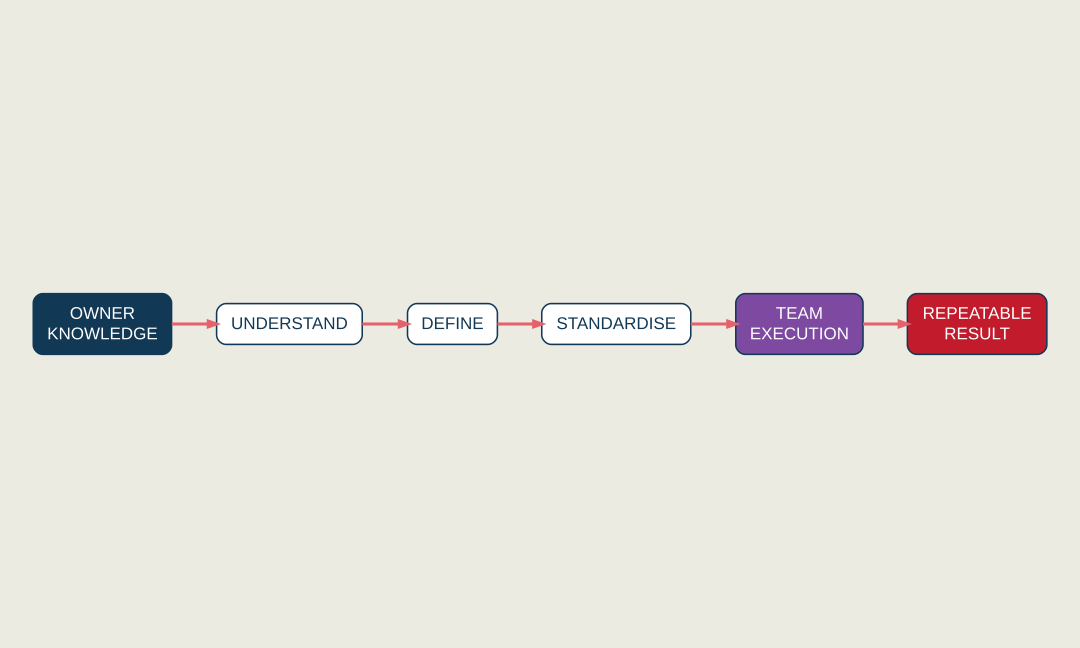
In a small business, people often make things work through experience, memory and informal communication. The owner knows what needs to happen, trusted people know how things are done and problems are solved as they appear.
That can work extremely well for a period. Growth changes the equation.
More customers, more people and more transactions create more opportunities for variation. What used to be “obvious” becomes dependent on who is doing the work that day.
The process problem is often invisible at first
A lack of defined process does not always show up as a dramatic failure. More often it appears as a collection of smaller frustrations:
- the same questions repeatedly reaching the owner;
- different team members producing different outcomes;
- new people taking too long to become effective;
- work being checked more often than it should be;
- customer experience changing depending on who handles the job;
- important steps being remembered only after something goes wrong.
Individually, each issue can look minor. Together, they consume capacity and increase owner dependency.
Defined does not mean complicated
Some owners resist process because they associate it with bureaucracy. That is understandable. A twenty-page manual nobody uses is not automatically better than a conversation.
The more useful question is: What needs to be clear so this work can be performed consistently without unnecessary escalation?
For one process, a short checklist may be enough. Another may need a workflow, template, training example or decision rule.
AEROPS and the role of Operations
Within the AEROPS Framework, defined processes sit primarily within Operations. But the consequences extend much further across margin, customer experience, people and owner dependency.
Clearer processes can support better margins because less work is repeated. They can improve customer experience. They can make recruitment and training easier. They can also give the owner more confidence to step away from tasks that have historically depended on them.
LPAD gives us a useful way to think about process
LPAD stands for Learn, Perfect, Automate, Delegate.
This article is about why defined processes matter as the business grows. LPAD provides the practical route for turning owner or expert knowledge into a repeatable system that can eventually be automated or delegated appropriately.
The order matters.
Before documenting or automating a process, understand it. Before handing it to somebody else, question whether unnecessary steps can be removed. Before buying technology, consider whether you are about to automate waste.
The objective is not simply to get work away from the owner. It is to turn knowledge into a system that the business can execute reliably.
Which processes should you look at first?
You do not need to document everything. Start with areas where clarity would release meaningful capacity or reduce risk.
Ask yourself:
- Which tasks repeatedly come back to me?
- Where does the team ask the same questions?
- Which processes take the most time?
- Where do mistakes or rework happen most often?
- Which activities would cause disruption if one particular person was unavailable?
- Where is customer experience inconsistent?
The owner-dependency test
Imagine you were unavailable for four weeks. Which activities would continue confidently? Which would slow down? Which would stop?
This is not about trying to make yourself irrelevant. It is about understanding where the business relies on your knowledge rather than on organisational capability.
That distinction becomes increasingly important as a business grows.
Process should create freedom, not rigidity
A good process provides enough structure for consistency while leaving room for judgement where judgement is needed.
If every exception has to return to the owner, the process is probably not complete. If employees are unable to respond sensibly to a customer’s needs because the procedure is too rigid, it may have gone too far in the other direction.
The mentoring opportunity is to find the level of structure appropriate for the business.
One process is enough to begin
Rather than launching a major process project, choose one recurring activity that causes friction. Understand it, simplify it and make the expected outcome clear.
Then ask what changed. Did questions reduce? Was the work easier to hand over? Did quality become more consistent? Did the owner regain time?
Those answers will tell you where to look next.
Related Insights
- What Is AEROPS? A Practical Framework for Sustainable Business Growth
- Owner Freedom: Why It Belongs in Your Growth Strategy
- The 6M’s of Business Growth: How Sustainable Change Becomes Lasting Progress
If your business is growing but too much still depends on you, business mentoring can help you identify where the dependency is really coming from, which processes deserve attention first and how to strengthen capability without creating unnecessary bureaucracy. Book your 30-minute Clarity Session.