
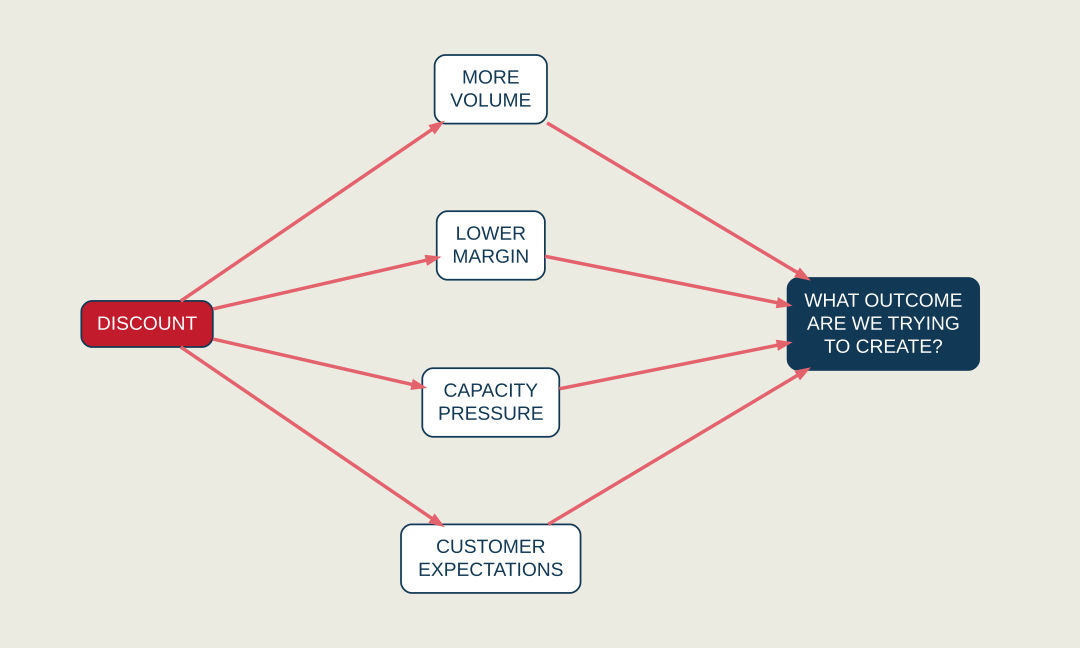
Discounting can produce an immediate response. Orders rise, enquiries increase and a slow period suddenly looks healthier.
That makes promotional pricing attractive, particularly when an owner feels pressure to create revenue quickly.
The danger is that the visible result is sales while the less visible result may be weaker margin, changed customer behaviour and more pressure on the business.
For the wider commercial question of how pricing supports margin, positioning and capacity, see Pricing Decisions: Why It Matters to Profitable Growth. This article focuses specifically on promotional pricing and discount-led activity.
Start with the objective, not the discount
Before deciding how much to reduce the price, ask what the promotion is actually intended to achieve.
Possible objectives might include:
- introducing a new customer to the business;
- moving excess or ageing stock;
- filling genuinely spare capacity;
- encouraging customers to try another service;
- creating urgency around a time-limited opportunity;
- supporting a strategic campaign.
“We need more sales” is usually too broad to tell you whether discounting is the right response.
What happens to the margin?
A discount comes directly out of the price, but many of the delivery costs remain.
That means a relatively small price reduction can require a surprisingly large increase in volume to produce the same gross contribution.
You do not need a complex model to begin the conversation. Ask:
- What margin do we normally make?
- What margin remains after the promotion?
- How many additional sales would we need to recover the difference?
- Can the operation absorb that volume without overtime, rework or service deterioration?
Revenue and Operations are connected
Within the AEROPS Framework, promotional pricing sits within Revenue → Spend. But its consequences can quickly move into Operations and People.
If a promotion produces a surge of work, what happens to delivery? Does the team cope? Do lead times increase? Are regular customers affected? Does the owner get pulled back into firefighting?
A commercially successful promotion should not quietly create an operational loss elsewhere.
What behaviour are you teaching the customer?
Regular discounting can change expectations.
If customers learn that a promotion appears every few weeks, there is little reason to buy at the normal price. The discounted price can become the perceived real price.
This does not mean promotions are always harmful. It means frequency, positioning and purpose matter.
Ask whether the promotion creates urgency for a specific reason or simply rewards people for waiting.
Could value be added instead of price removed?
Sometimes the commercial objective can be achieved in another way.
Could you bundle a relevant product? Include an additional service with low delivery cost but high perceived value? Reward loyalty? Provide a faster option? Create a limited package?
The right answer depends on the business, but exploring alternatives can prevent price from becoming the only marketing lever.
Review what happened after the promotion
A promotion is an experiment. Treat it like one.
Look beyond the number of sales. Consider:
- gross profit generated;
- new versus existing customers;
- repeat behaviour afterwards;
- capacity used;
- customer acquisition cost;
- effect on full-price sales;
- operational problems created;
- whether the objective was actually achieved.
The learning may be more valuable than the campaign itself.
Questions before your next promotion
- What exact behaviour are we trying to create?
- Why is a price promotion the right mechanism?
- What margin are we prepared to trade for that outcome?
- What happens if demand is much stronger than expected?
- What happens if existing customers simply move purchases into the promotional period?
- How will we judge whether the promotion worked?
Use promotions deliberately
Promotional pricing can be useful when it is connected to a clear commercial objective and understood within the wider business. It should be a deliberate commercial choice rather than the default response to a slow week or a sales target that has been missed.
It becomes dangerous when discounting is the automatic response to uncertainty, weak demand or sales pressure.
The mentoring question is not “Should you discount?” It is “What outcome are you trying to create, and is discounting the healthiest way to create it?”
If revenue is growing but margin or capacity feels increasingly pressured, business mentoring can help you step back from the immediate sales number and examine the wider commercial picture. Book your 30-minute Clarity Session.