
Owner dependency often looks like a people problem, but underneath it is frequently a knowledge problem.
The owner knows how to quote the unusual job, calm the difficult customer, approve the purchase, check the quality, resolve the exception and decide what happens next. The team may be capable, but the business has never converted that knowledge into a repeatable way of working.
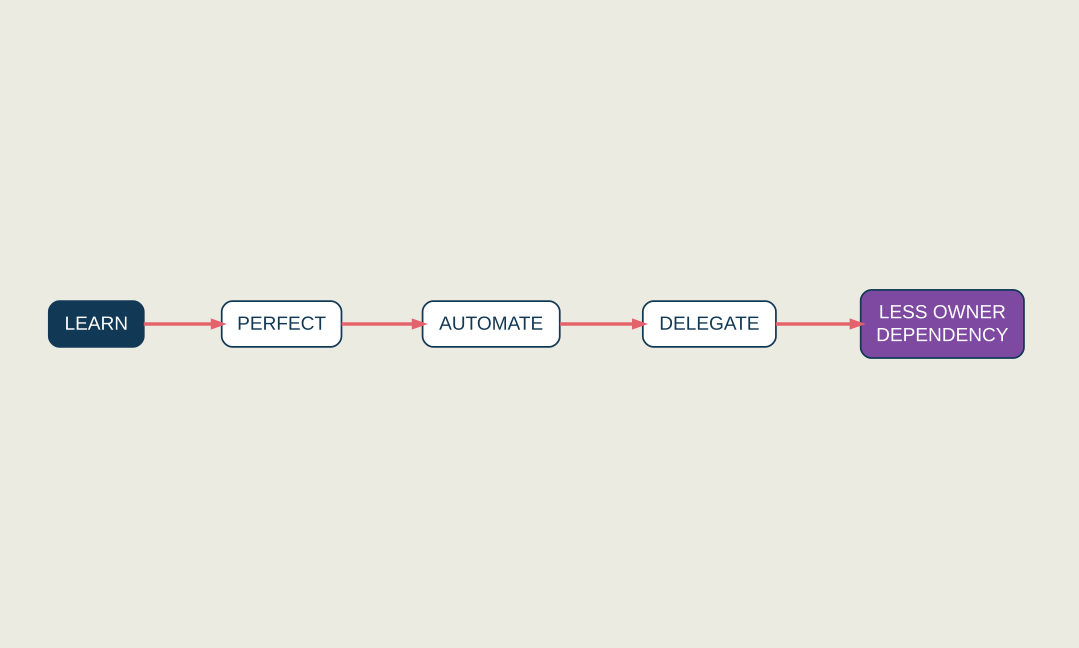
The LPAD methodology provides a practical route for doing that:
Learn → Perfect → Automate → Delegate
A useful shorthand is: LPAD turns what you know into a system the business can execute without depending on you.
Learn: understand the work before changing it
It is tempting to document a task from memory or hand it over because you are tired of doing it. That can transfer confusion rather than capability.
Learning means understanding what actually happens, why each step exists, what a good outcome looks like and where judgement is required.
Questions worth asking include:
- What triggers the process?
- What outcome is expected?
- What decisions are made along the way?
- Where do exceptions occur?
- What information is needed?
- What does the owner know that has never been written down or explained?
Perfect: improve before you reproduce
Perfect does not mean flawless. It means improving and standardising the work sufficiently before building it into the business.
Remove unnecessary steps. Clarify decisions. Fix obvious weaknesses. Define what good looks like. Make the process repeatable.
A useful question is: If I had to teach this to a capable new person tomorrow, what would I simplify first?
Automate: remove manual effort where it makes sense
Automation can be valuable, but it should follow understanding and improvement.
Automating a poor process can simply make poor work happen faster.
Consider where technology, templates, workflows, reminders, integrations or standard communications could remove repetitive effort. Keep human judgement where judgement adds value.
The objective is not maximum automation. It is appropriate automation.
Delegate: transfer responsibility, not just tasks
Delegation is the stage owners often want to reach first, but it works better when the earlier stages have been completed.
Clear delegation includes the expected outcome, appropriate authority, relevant measures and accountability.
It should also take place at the lowest appropriate capable level. Senior people should not be carrying work simply because they have always carried it.
Delegation is not abdication. The owner or leader remains responsible for creating clarity and appropriate oversight.
Why the order matters
Imagine delegating a process nobody properly understands. The recipient asks questions, the owner becomes frustrated and eventually takes the task back.
Or imagine automating a process full of unnecessary steps. The business invests time and money making inefficiency more permanent.
LPAD slows the thinking down so the business can speed the work up later.
Where should you use LPAD first?
LPAD is especially useful where a recurring activity should be consistent but still depends too heavily on one person. If you first want to explore why defined processes matter as a business grows, read Defined Processes: Why It Matters More as the Business Grows.
Start with recurring activities that create one or more of these symptoms:
- the owner is repeatedly interrupted;
- the same problem keeps returning;
- one person holds critical knowledge;
- quality varies unnecessarily;
- manual administration consumes skilled time;
- the team can do the task but lacks authority or confidence;
- the owner cannot step away because too much relies on personal judgement.
LPAD and AEROPS work together
The AEROPS Framework can help identify where owner dependency is affecting the business, particularly within Analyse, Operations and People.
The LPAD methodology then gives you a structured way to work through a specific activity or process.
The important point is that these tools should reduce complexity, not add to it. Choose one meaningful area and work through it thoughtfully.
Try the four-question test
Pick one activity you would like to stop owning personally and ask:
- Learn: Do we truly understand how this works?
- Perfect: What could be simplified or clarified?
- Automate: What manual effort could be removed?
- Delegate: Who is the lowest appropriate capable person to own the outcome?
The answers may show that the task is ready to move, or that there is work to do before it should.
If too much of the business still sits in your head, business mentoring can help you identify where the dependency sits and work out the next sensible move. Book your 30-minute Clarity Session.