
Many business owners spend considerable time thinking about how to increase sales and surprisingly little time questioning whether their pricing still makes sense.
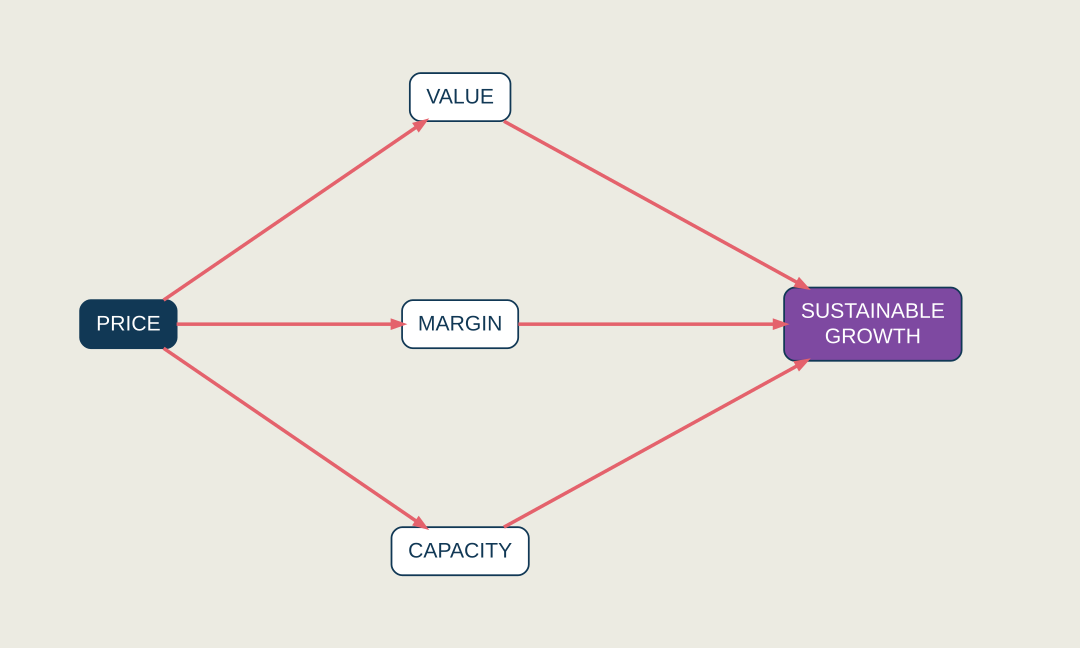
That matters because pricing affects far more than revenue. It influences margin, customer expectations, positioning, cash generation, team capacity and how hard the business has to work to achieve its goals.
The mentoring question is not simply, “Should you put your prices up?” It is, “What is your current pricing telling you about the business?”
Growth can expose weak pricing
A price that worked when the business was smaller may become a problem as costs, wages, systems and service expectations increase.
The danger is that higher turnover can disguise this for a while. The business appears to be growing, but each additional sale may contribute less than expected. The owner then responds by chasing more volume, which can create even more operational pressure.
Before assuming the solution is more sales, it is worth exploring whether the existing sales are commercially healthy.
Pricing sits inside a bigger picture
Within the AEROPS Framework, pricing sits primarily within Revenue, but it is connected to several other areas of the business.
- Analyse: Do you understand product or service margins, breakeven and cashflow?
- Expand: Are you attracting customers who value what you do?
- Revenue: Is the price supporting the margin the business needs?
- Operations: Can delivery be efficient at the current price?
- People: Are team costs and capability reflected in what you charge?
- Success: Does the pricing model support the kind of business and life you are trying to build?
Questions worth asking about your current prices
- When did you last review pricing properly rather than simply compare yourself with competitors?
- Which products or services produce the strongest contribution?
- Which customers consume significantly more time than the price allows for?
- Where have costs increased without being reflected in the price?
- Are discounts being used deliberately or because the team lacks confidence?
- Would some customers actually value a higher-level offer?
- Are you pricing for the business you have today or the business you had two years ago?
Price is also a positioning signal
Owners sometimes worry that increasing prices will automatically reduce demand. That can happen, but price is only one part of the customer’s decision.
Speciality, trust, speed, quality, convenience, expertise, risk reduction and the cost of getting the decision wrong can all influence perceived value.
This is why a pricing conversation often becomes a positioning conversation. If the business cannot clearly explain why it is different or valuable, price carries too much of the burden.
What happens if you do nothing?
A useful coaching question is to consider the cost of leaving pricing unchanged.
If wages and supplier costs continue to rise, what happens to margin? If the team is already stretched, what happens when more low-margin work arrives? If the owner is compensating for weak pricing by working longer hours, what is that costing personally?
Sometimes the risk of keeping a price is greater than the risk of changing it.
Pricing strategy is bigger than putting prices up
A pricing review should not begin with an assumption that every customer needs the same increase. The wider question is whether the pricing model still supports the value being delivered, the margin required and the capacity available.
That may lead to a price increase, but it could also lead to changing packages, removing low-value work, creating clearer service levels, introducing minimum order values or improving how value is communicated.
A pricing review does not have to mean a blanket increase
There are several possibilities to explore. Different customer segments may support different offers. Some services may need redesigning. Low-value activities might be removed. Minimum order levels may need reconsidering. A premium option might be appropriate. Some prices may be fine exactly where they are.
The important thing is that pricing becomes a conscious commercial decision rather than an inherited number.
What would healthier pricing allow you to do?
Consider what improved margin could make possible. Could it fund better people, stronger systems, more resilience, investment in growth or simply reduce the volume of work needed to achieve the same outcome?
That changes the conversation from “How much can we charge?” to “What pricing supports the business we are trying to build?”
Related Insights
- What Is AEROPS? A Practical Framework for Sustainable Business Growth
- Defined Processes: Why It Matters More as the Business Grows
- Vision and Mission: A Practical Guide for Growing Business Owners
If pricing is one of several growth pressures you are trying to untangle, business mentoring can provide space to examine the numbers, positioning, capacity and assumptions before deciding what fits your business. Book your 30-minute Clarity Session.